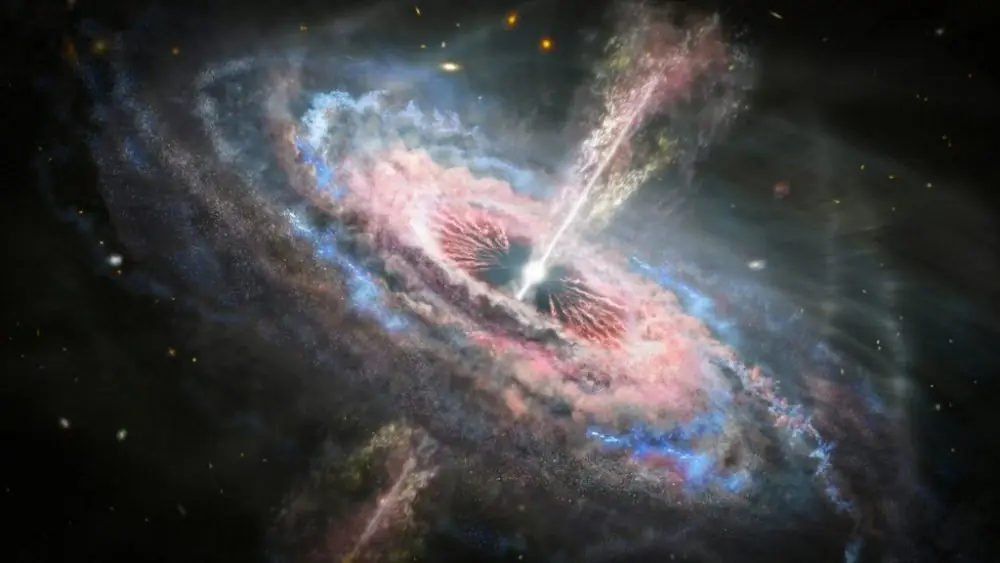
A supermassive black hole just pulled off something that sounds like science fiction. It blasted out a jet so powerful that it makes the Death Star laser look like a toy. This was not a movie prop or a wild theory. It was a real cosmic event that forced astronomers to rethink how black holes behave.
The black hole sits in a distant galaxy and earned the nickname Jetty McJetface. Its official event name is AT2018hyz. What started as a routine observation turned into one of the most energetic outbursts ever recorded in the universe.
The Star Just Got Too Close
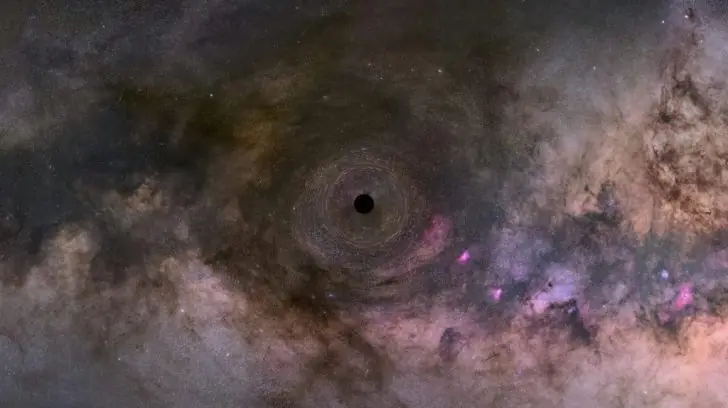
The shredded star did not vanish all at once. Its remains formed a bright, swirling disk around the black hole. That hot disk glowed for months, then slowly faded as astronomers expected it would.
For a while, AT2018hyz seemed ordinary. Telescopes picked up light from the initial blast, then the system appeared to calm down. Most tidal disruption events fade within months, and researchers moved on to other targets.
Then something strange happened years later. In 2022, radio telescopes noticed that the system was getting brighter again. Instead of fading into the background, it flared up with new energy that kept increasing over time.
A Jet That Dwarfs Science Fiction
To explain how extreme this jet is, scientists reached for a pop culture comparison. They pointed to the planet-killing superlaser from “Star Wars Episode IV: A New Hope.” Fans have long estimated that the fictional Death Star would need the power of about 600,000 suns to destroy a planet.
Jetty McJetface outdid that by an absurd margin. It’s jet released between a trillion and 100 trillion times more energy than those fan estimates. That number is not a typo, and it is hard to wrap your head around.
In scientific terms, the event packs roughly 5 × 10^55 ergs of energy if it comes from a relativistic jet. By comparison, the Sun’s peak energy output sits around 10^33 ergs. That gap shows just how extreme this outburst really is.
The lead researcher, Yvette Cendes, emphasized how unusual the brightening has been. She noted that it is difficult to think of anything else in space that has continued to grow brighter for years like this. Most similar events peak quickly and then fade away.
If a planet were unlucky enough to sit within a few light-years of that jet’s path, it would not survive. The intense radiation would strip atmospheres and scorch surfaces beyond repair. This is cosmic destruction on a scale that makes science fiction look modest.
What the Delay Means?
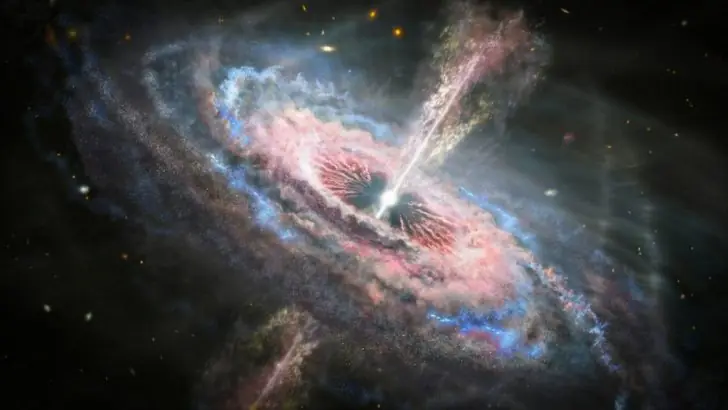
That delay breaks from what many models predicted.
Relativistic jets from tidal disruption events are rare to begin with. Only about one percent of known cases produce these narrow, near-light-speed beams. Most events create slower, more rounded outflows of gas.
Astronomers suspect geometry may explain the late reveal. When a jet first forms, it shoots out as a tight beam. If that beam was not pointed toward Earth at the start, telescopes would have missed its full intensity.