
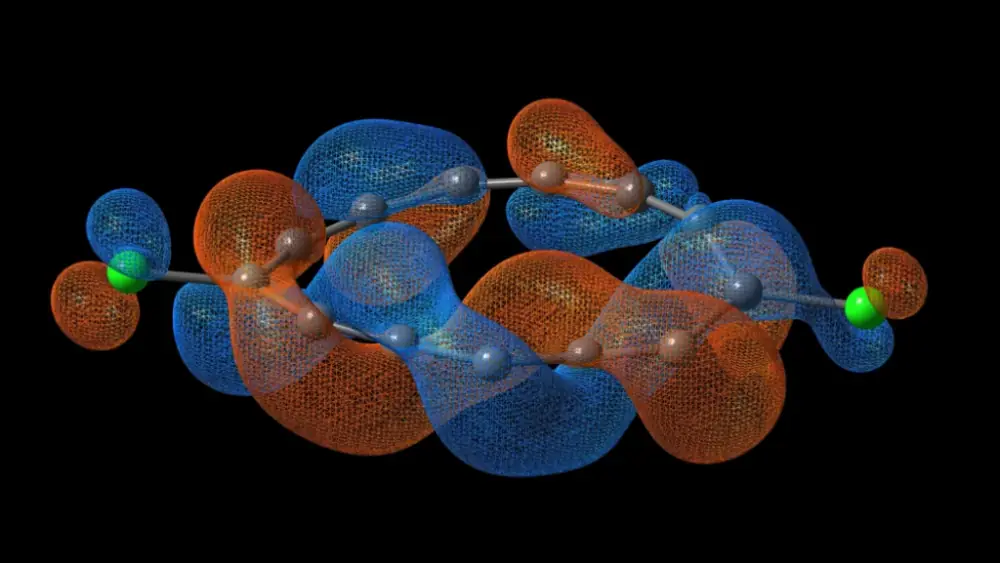
Chemistry rarely surprises researchers with shapes that no one predicted. Yet a team of scientists recently built a molecule so unusual that theory had never fully imagined it. The structure behaves like a twisted loop that refuses to follow the normal rules of molecular symmetry.
Researchers call this strange structure a “half-Möbius” molecule. The name comes from the famous Möbius strip, a looped band with a single twist that forms one continuous surface. Chemists have made Möbius-style molecules before, yet this one behaves in a way that pushes far beyond the classic concept.
The discovery, published in the Science journal, required years of precision tools, deep theoretical work, and extreme laboratory conditions. The result is a molecular structure that challenges how scientists think about electrons, topology, and the limits of chemistry.
The Molecular Twist No One Expected

The surprise hides inside the behavior of the electrons. In this molecule, the electrons do not stay tied to a single atom. They move freely around the carbon ring in a shared system called conjugation.
This roaming cloud of electrons gives the molecule its unusual identity. As the electron wave moves around the ring, its orientation slowly twists. Each lap around the molecule rotates the wave by ninety degrees.
That twist creates a remarkable effect. The electron wave must circle the ring four full times before returning to its original state. A classic Möbius system requires only two loops to complete the same cycle.
This four-loop behavior forms a completely new molecular topology. No natural molecule has ever shown this pattern. Even theoretical chemists had not predicted a structure quite like it.
Built Atom by Atom in Extreme Conditions
Nature never had a chance to produce this molecule on its own. The structure is too fragile and unstable to survive in ordinary environments. Researchers had to assemble it under carefully controlled laboratory conditions.
The team worked at IBM Research Europe in Zurich. They built the molecule on top of a thin insulating layer placed over a gold surface. The experiment took place at temperatures only a few degrees above absolute zero.
Such freezing temperatures keep atoms from moving around. Even tiny vibrations could destroy a delicate molecular arrangement. Cold conditions allow scientists to manipulate atoms with extreme precision.
The researchers used a scanning tunneling microscope, often shortened to STM. This device can image individual atoms and move them with astonishing accuracy. It works by sending tiny electrical currents through a needle tip hovering above a surface.
Scientists began with a precursor molecule containing extra chlorine atoms. They applied carefully measured voltage pulses through the microscope tip. Each pulse removed one chlorine atom from the structure.
This slow stripping process reshaped the molecule step by step. Eventually, only the desired carbon ring with two chlorine atoms remained. The result was the strange C13Cl₂ structure with its twisted electronic topology.
Switching the Molecule’s Shape on Demand

The microscope tip can deliver a small electromagnetic pulse to the molecule. That pulse nudges the electronic structure into a new configuration. The molecule then switches into a different twisted state.
In one form, the half Möbius twist turns left. And in another version, the twist flips to the right. The molecule can also relax into a flat configuration that loses the unusual topology entirely.
This switching behavior happens at the level of electron waves. The atoms themselves barely move. Instead, the electronic pattern reorganizes inside the molecular ring.
Researchers also see potential for molecular electronics. Devices built from single molecules could someday perform tasks that traditional circuits cannot handle. A controllable topology adds a powerful new design tool.